
Lenses
GRADE 11
•
PHYSICS

Explore how light bends at a spherical boundary between two transparent media, and discover the relationship between object distance, image distance and radius of curvature.
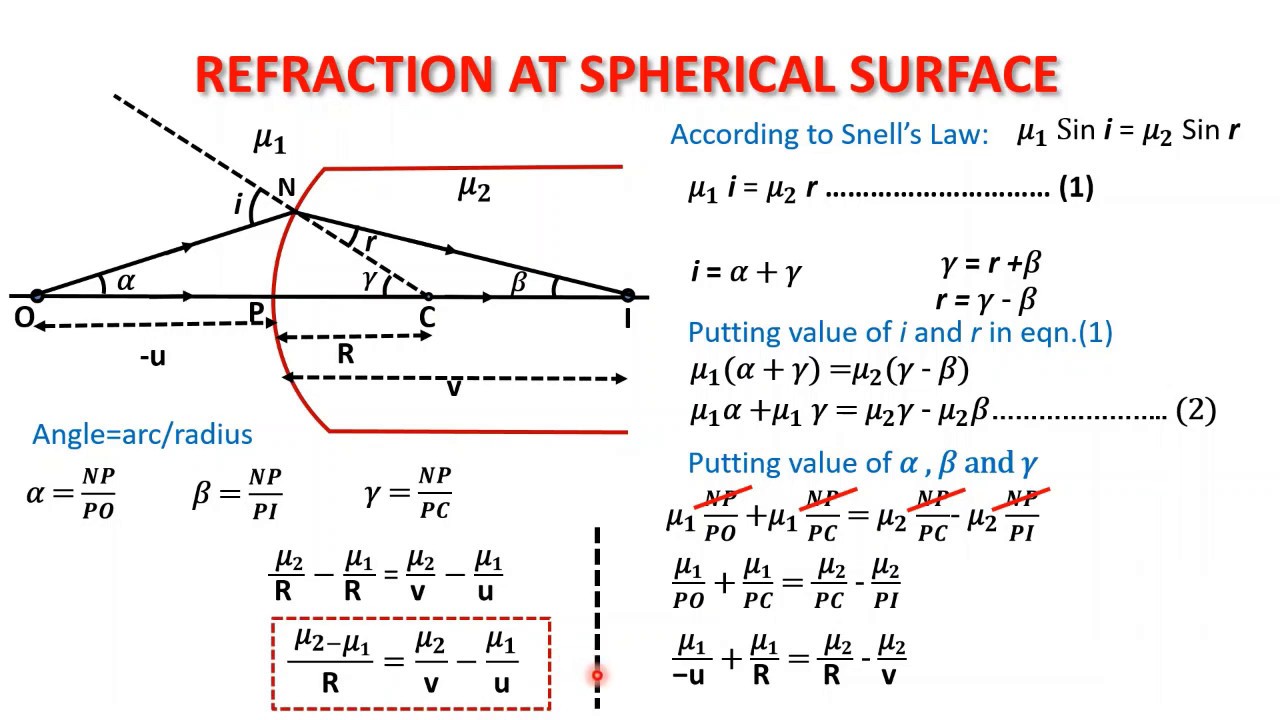
Consider a spherical surface of radius R separating the two media 1 and 2 as shown in Figure (8.1). The two rays from point object O are incident on the curved surface. The ray incident at A will be refracted at the surface and meet the ray propagating along the axis at point I. The ray incident along the axis is incident on the surface normally and hence is not bent. The point object O thus has its image at I.
For paraxial rays close to the principal axis, the angles α, β, γ, θ₁ and θ₂ are very small. This allows us to use the small-angle approximation.
The point from which the incident light rays originate.
The incident ray changes direction at the curved boundary.
The refracted rays meet, or appear to meet, to form an image.
We can derive the refraction formula using Snell's law, small-angle approximation and the geometry of the spherical surface.
From Snell's law:
For very small angles expressed in radians, sin θ is approximately equal to θ.
From triangle OAC and triangle IAC:
For a ray at height h above the principal axis:
Substitute the angle relations into the small-angle form of Snell's law.
Here n₁ and n₂ are the refractive indices of the two media, u is object distance, v is image distance, and R is the radius of curvature. Signed distances must be used consistently with the textbook convention.
If the first medium is air, its refractive index is approximately 1. Let the second medium have refractive index n.
For refraction at a spherical surface, the radius R is positive if the surface is convex toward the object, whereas R is negative if the surface is concave toward the object.
The surface bulges toward the object. The centre of curvature lies on the opposite side of the surface.
The surface curves inward toward the object. The centre of curvature lies on the object's side.
An air bubble is at the centre of a glass sphere of radius 6 cm and refractive index 1.5. Find the distance of the image when viewed from outside.
Why is the image at the bubble's position? Because the bubble is at the centre of the sphere, rays travelling from it strike the spherical surface normally. They do not change direction, so the apparent position remains at the centre.
A curved transparent surface changes the direction of an oblique light ray because light travels at different speeds in different optical media. The exact path depends on the refractive indices and the angle of incidence.
View more Lenses images on Wikimedia CommonsState the sign convention for radius of curvature for refraction of light at a spherical surface. Illustrate your answer with a diagram.
The radius of curvature R is positive when the surface is convex toward the object and negative when the surface is concave toward the object. Refer to the two diagrams in the Sign Convention section above.